★★★★★
★★★★★
Verified Buyer
Amazing products and fast shipping. I’m very happy with my purchase.
Uso del producto: Este producto está destinado exclusivamente a la investigación.
Toda la información de los productos de este sitio web tiene fines exclusivamente educativos. Cualquier forma de introducción en el cuerpo de personas o animales está estrictamente prohibida por la ley. Este producto solo debe ser manipulado por profesionales autorizados y cualificados. No es un medicamento, alimento ni cosmético y no debe etiquetarse, utilizarse ni presentarse como tal.
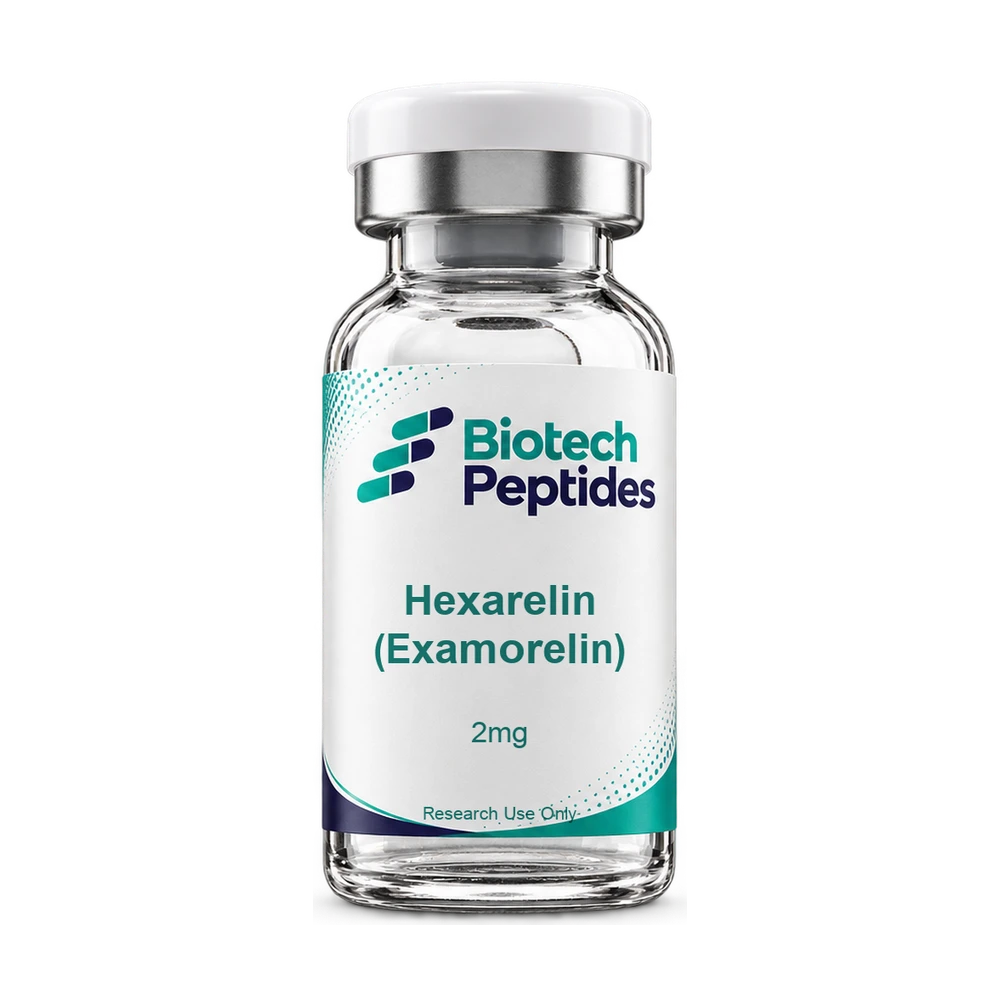
Hexarelin (Examorelin) is a synthetic hexapeptide growth hormone secretagogue and one of the most potent GHS-R1a agonists identified.
Durante el cambio de envase, puedes recibir productos con la etiqueta anterior o con la nueva. La formulación, la pureza y la calidad siguen siendo exactamente las mismas, según nuestros estándares.
-25% en todo – hasta el 31 de octubre
25% sobre los precios habituales, en sustitución de otras ofertas. Acumulable solo con el descuento crypto.
Envío en el día para pedidos en EE. UU. realizados antes de las 12:00 EST.
Ver la política de envíos →Devoluciones sin complicaciones en 30 días para productos sin abrir.
Ver la política de devoluciones →Cada lote se analiza para comprobar su pureza, potencia y calidad.
Ver resultados de laboratorio →Hexarelin (Examorelin) is a synthetic hexapeptide growth hormone secretagogue and one of the most potent GHS-R1a agonists identified. Binding to GHS-R1a activates Gq/11-mediated phospholipase C signalling, resulting in IP3/DAG generation, intracellular calcium mobilization, and downstream secretagogue-associated signalling pathways.
Unlike other members of the GHRP class, Hexarelin also interacts with CD36 (scavenger receptor class B), providing a secondary signalling mechanism independent of GHS-R1a activation.
This dual receptor profile makes Hexarelin a valuable research tool for investigating GHS-R1a pharmacology, receptor-signalling dynamics, secretagogue potency relationships, CD36-mediated signalling pathways, and comparative peptide pharmacology.
Experimental studies have also utilized Hexarelin in investigations of receptor cross-talk, intracellular signalling networks, and peptide-receptor selectivity. Supplied as lyophilized preparation (2 mg/vial).
| Chemical Formula | C47H58N12O6 |
|---|---|
| Synonyms | Examorelin, EP-23905, MF-6003, His-D-2-Me-Trp-Ala-Trp-D-Phe-Lys-NH2 |
| Molar Mass | 887.05 g/mol |
| CAS Number | 140703-51-1 |
| PubChem CID | 6918297 |
| Total Compound Content | 2 mg per vial |
| Shelf Life | 36 months |
Every batch is independently lab tested for identity, purity and potency. View our lab testing program →
CD36 (cluster of differentiation 36), also known as fatty acid translocase (FAT), is a class B scavenger receptor involved in lipid transport, fatty acid uptake, oxidized lipid recognition, and cellular metabolic signalling.
Hexarelin is unique among GHS-R1a agonists in that it also interacts with CD36, providing a second pharmacological mechanism independent of growth hormone secretagogue receptor activation.
This dual receptor profile makes Hexarelin a valuable research tool for investigating receptor-specific signalling pathways, metabolic regulation, lipid-sensing mechanisms, and the distinction between GHS-R1a-mediated and CD36-mediated biological effects.
Hexarelin is widely regarded as one of the most potent peptide agonists of GHS-R1a. Comparative pharmacology studies frequently utilize Hexarelin as a reference compound when evaluating receptor affinity, agonist efficacy, signalling kinetics, and downstream pathway activation among members of the GHRP class.
Its high receptor potency and well-characterized signalling profile have established it as a standard tool in GHS-R1a research and comparative secretagogue pharmacology.
In addition to its role in GHS-R1a signalling research, Hexarelin is used to investigate CD36-associated pathways, receptor cross-talk mechanisms, lipid-regulated signalling networks, cellular stress-response pathways, and comparative receptor pharmacology. The presence of both GHS-R1a and CD36 activity allows researchers to design experiments that differentiate receptor-specific signalling events and examine the interaction between distinct peptide-responsive pathways within the same experimental system.
Amazing products and fast shipping. I’m very happy with my purchase.
The quality and speed of delivery impressed me. I'll be shopping here again.
Worth every penny! High-quality products and fast shipping.
Highly satisfied with the support team and purity exceeded my expectations. A trustworthy supplier. My laboratory research results exceeded expectations.
Great quality on the fast turnaround times, purity is outstanding. Will buy again. Results from my tests exceeded all expectations.
The research results have been great so far. Great quality on the customer service and it's an exceptionally pure batch. Will purchase again soon.
Great quality on how fast it shipped. the product is of excellent quality. My test results are great. Highly satisfied customer.
Extremely pleased with how fast it shipped. happy with the quality of this compound. The research results have been great so far. Excellent all-round service.
Truly happy with the support team and the chemical quality is top notch. My test results are great. Will buy again.
The research results have been great so far. Great experience with the fast turnaround times, it's an exceptionally pure batch. Reordering next week.
Really happy with the fast turnaround times, the quality is absolutely top-tier. The research results have been great so far. Will buy again.
Exceptional service on the fast turnaround times, the chemical quality is top notch. Highly satisfy and will return. We got fantastic research results.