★★★★★
★★★★★
Verified Buyer
Really good price. Thanks to you guys.
Verwendung: Dieses Produkt ist ausschließlich für Forschungszwecke bestimmt.
Alle Produktinformationen auf dieser Website dienen ausschließlich Bildungszwecken. Jede Form der Einbringung in den Körper von Menschen oder Tieren ist gesetzlich streng verboten. Dieses Produkt darf nur von zugelassenen und qualifizierten Fachleuten gehandhabt werden. Es ist kein Arzneimittel, Lebensmittel oder Kosmetikum und darf nicht als solches gekennzeichnet, verwendet oder falsch etikettiert werden.
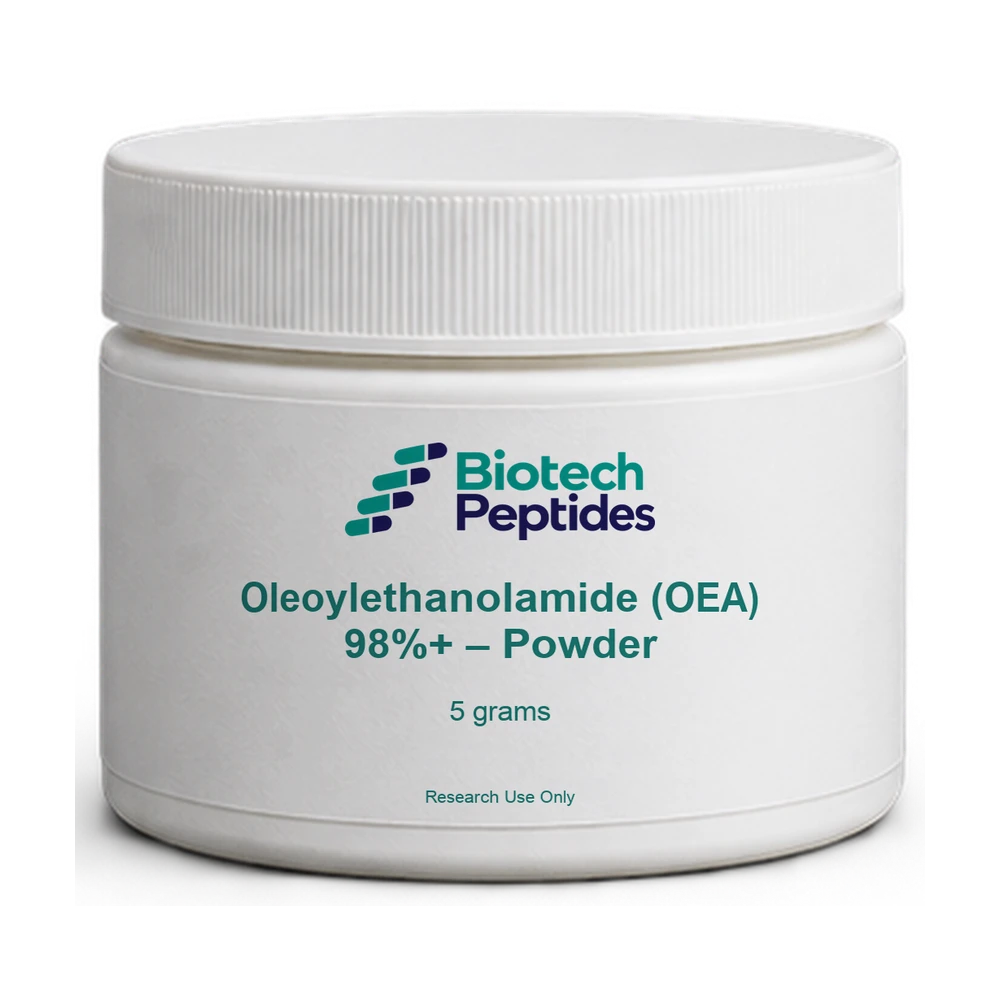
Oleoylethanolamide (OEA) is an ethanolamide lipid derived from oleic acid, classified within the N-acylethanolamine family of bioactive lipid signalling molecules.
Während der Umstellung unserer Verpackung erhalten Sie möglicherweise Produkte mit dem bisherigen oder dem neuen Etikett. Formulierung, Reinheit und Qualität bleiben nach unseren Standards genau gleich.
-25% auf alles – bis 31. Oktober
25% auf reguläre Preise statt anderer Angebote. Nur mit dem Krypto-Zahlungsrabatt kombinierbar.
Jede Charge wird auf Reinheit, Wirksamkeit und Qualität geprüft.
Laborergebnisse ansehen →Oleoylethanolamide (OEA) is an ethanolamide lipid derived from oleic acid, classified within the N-acylethanolamine family of bioactive lipid signalling molecules. Research interest centers on its function as an endogenous agonist of peroxisome proliferator-activated receptor alpha (PPAR-alpha), a nuclear receptor governing lipid metabolism gene transcription.
Research applications include PPAR-alpha pathway studies, lipid signalling research, and N-acylethanolamine biosynthesis/degradation pathway investigation.
| Chemical Formula | C20H39NO2 |
|---|---|
| Synonyms | n-oleoylethanolamine, oleoylethanolamide, N-(2-Hydroxyethyl)oleamide, Oleylethanolamide, Oleamide MEA, N-oleoyl ethanolamine |
| Molar Mass | 325.5 g/mol |
| CAS Number | 111-58-0 |
| PubChem CID | 5283454 |
| Total Compound Content | 5 grams |
| Shelf Life | 36 months |
Every batch is independently lab tested for identity, purity and potency. View our lab testing program →
OEA binds directly to and activates peroxisome proliferator-activated receptor alpha (PPAR-alpha), a ligand-activated nuclear transcription factor that, upon activation, heterodimerizes with retinoid X receptor (RXR) and binds PPAR-response elements in target gene promoters to upregulate fatty acid oxidation and lipid metabolism genes. Cell-based PPAR-alpha transactivation reporter assays, using a PPAR-response-element-driven luciferase construct, are the standard method for confirming and quantifying OEA's agonist activity at this receptor relative to synthetic PPAR-alpha agonist reference compounds (such as fenofibrate).
OEA is synthesized via hydrolysis of N-acylphosphatidylethanolamine (the same precursor class that generates other N-acylethanolamines, including the endocannabinoid anandamide) and is degraded by fatty acid amide hydrolase (FAAH), the same enzyme that degrades anandamide. This shared biosynthetic and degradative machinery means that FAAH inhibitor compounds, used in endocannabinoid research, also affect OEA levels — a consideration relevant to experimental design when FAAH inhibitors are used and PPAR-alpha-mediated effects need to be distinguished from cannabinoid-receptor-mediated effects.
Standard FAAH activity assays measure the enzymatic hydrolysis rate of OEA (or a fluorogenic/radiolabeled substrate analog) into oleic acid and ethanolamine, typically using tissue homogenates, recombinant FAAH enzyme preparations, or cell lysates. These assays allow researchers to characterise FAAH kinetic parameters (Km, Vmax) with OEA as substrate and to evaluate the potency of FAAH inhibitor compounds, which indirectly elevate OEA tissue concentration by blocking its primary degradation pathway.
Really good price. Thanks to you guys.
Good price for this good product. I will order again. Thank you.
Very happy with the ordering process and quality was great and dispatch was incredibly fast. Reordering next week. My test results are great.
Great experience with the ordering process and quality is stellar. Highly consistent test results. Excellent all-round service.
Our lab's research outcomes exceeded what we expected. Fantastic results using the fast turnaround times, quality was great and dispatch was incredibly fast. Reordering next week.
I'm very happy with how fast it shipped. the quality is absolutely top-tier. Our lab's research outcomes exceeded what we expected. Reordering next week.
Cannot recommend enough the fast turnaround times, the compound is pure and high quality. Great value. Our research results have been outstanding.
Great service! Received order fast.